Andy's blog

Andy's picture

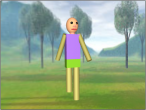
Walking man

Walking man

This is another test of animation in VRMath2. The construction of the man utilises basic 3D primitives including sphere, cone, sylinder, and cube. It is basically a trial and error approach to scale and apply material settings onto those 3D primitive objects. 

Animation is then applied to the arms and legs by careful considerations about their positions and orientations of movements.


Andy's picture

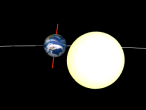
Rotating Earth orbiting the Sun

Rotating Earth

This is a simple Earth and Sun model. This model is not to scale in terms of size and distance.

The rotation and revolution speeds are roughly to scale. The Earth in this model is rotating at 1 second per rotation. It is also revolving at 365 seconds per revolution.

The Earth has a tile of 23.5 degrees on its rotation axis to the orbiting plane. There are also some background stars (points). This model can be easily created using VRMath2 Editorsmiley

Andy's picture

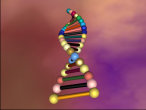
Simple DNA Model

DNA model

It was Wednesday, 17th of July. I met with a visiting scholar Xie Zuo Ru from China.  Xie is an awarding-winning high school teacher in the area of technology education. His research interests focused on the use of interactive media to promote science, technology, engineering and mathematics (STEM) education.  The interactive media refers to the small computers such as Arduino and Raspberry Pi that are affordable, programmable, and capable of transforming virtually any objects into input and output devices.  A wide range of interactive media applications such as turning a drawing of keyboard into a real keyboard or remote control of household appliances makes the teaching and learning fun and creative. He is also an expert in robotics and programming.

Andy's picture

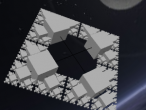
Cayley graph 3D

Cayley graph 3D

I was in the keynote session of AAMT conference. In the keynote, the mathematician Hanna Neumann was mentioned. I immediately googled and started reading about her on Wikipedia.

While reading, my thoughts are like the hyperlinks that go everywhere, then suddenly I saw and clicked into the Group theory, where I found the Cayley graph that caught my attention.

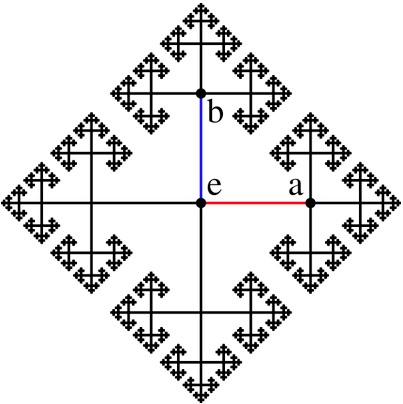
It is easily recognisable that this cayley graph is a fractal image, which can be produced with a simple recursive procedure in VRMath2's LOGO language.

Andy's picture

12 Tables

12 tables

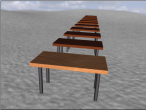
In this blog, I am trying to use an existing LOGO program in VRMath2 called table.logo, then see if I can create a couple of tables using repeat command.